2 One-dimensional waves and the wave equation
2.1 Non-dispersive, linear waves in one-dimension
To begin, we will examine the simplest type of wave imaginable — a non-dispersive, linear wave in one-dimension. Let’s define some of these terms.
Example 2.1 (Linear) A linear wave is one that satisfies a linear wave equation. But what does this mean? It means that we will be able to superpose waves. That is, given the formula for two waves that satisfy the wave equation, the sum of the two waves will also satisfy the equation1. Or, stating this more loosely, when two waves meet we can just add them up.
1 We can also multiply the wave by some factor, e.g. 2, 0.5 or -3, to obtain yet more solutions.
Example 2.2 (Dispersion) Dispersion describes the effect where different frequencies of wave travel at different speeds. Since a general wave-form can be considered as the sum of simple waves of different frequencies, dispersion would result in a change of the shape of a wave as it propagates. For now we consider waves without dispersion so, in one dimension, a wave heading to the right will maintain its shape.
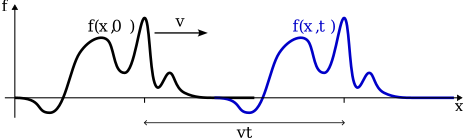
To begin, we will only consider waves moving to the right at a constant velocity, \(v\) and maintaining their form. Then at time \(t\), the height of the wave \(f\) at position \(x\) must be the same as the value that the original wave (at \(t = 0\)) had at \(x - vt\). In other words, \[ f(x, t) = f(x - vt, 0). \] If we define \(g(x) = f(x, 0)\), then we have \[ f(x, t) = g(x - vt), \] where \(g\) can represent any initial shape the initial wave form may take. That is, provided \(f(x, t)\) can be written as a function of \(x - ut\) then it will be a suitable (right-moving) wave. Hence \[ f(x, t) = \cos(x - vt) \] and \[ f(x, t) = e^{\left(x - vt\right)^2} \] are both suitable formulae for describing such waves, while \[ f(x, t) = \cos(x^2t - v) \] is not.
What happens if we have a wave moving to the left. In that case, the same reasoning indicates that \(f(x, t)\) must be a function of \(x + vt\), e.g. \[ f(x, t) = \cos(x + vt) \]
2.2 The wave equation
Last year you saw a derivation of the wave equation for waves on a string. In the appendices, I also include a proof, from Maxwell’s equations, that electromagnetic waves also follow the wave equation, in three dimensions2. Therefore, in this section, we will merely demonstrate that, in one dimension, the wave equation produces solutions of the type we have seen above. We will also extend the wave equation into 3 dimensions.
2 Revisit this after studying electromagnetism.
3 Check this solution by taking the partial derivative with respect to \(p\).
In one dimension, the wave equation is \[ \boxed { \frac{\partial^2f}{\partial x^2} = \frac{1}{v^2}\frac{\partial^2f}{\partial t^2}. } \] Let’s attempt to find the general solution to this equation. We start with an inspired substitution. Let \(p = x + vt\) and \(q = x - vt\). Then, using the chain rule for partial derivatives, we find that \[ \begin{aligned} \frac{\partial}{\partial x} &= \frac{\partial p}{\partial x}\frac{\partial}{\partial p} + \frac{\partial q}{\partial x}\frac{\partial}{\partial q}\\ &= \frac{\partial}{\partial p} + \frac{\partial}{\partial q} \end{aligned} \] and so \[ \begin{aligned} \frac{\partial^2}{\partial x^2} &= \left(\frac{\partial}{\partial p} + \frac{\partial}{\partial q}\right)\left(\frac{\partial}{\partial p} + \frac{\partial}{\partial q}\right)\\ &= \frac{\partial^2}{\partial p^2} + 2\frac{\partial^2}{\partial p\partial q} + \frac{\partial^2}{\partial q^2}. \end{aligned} \] Meanwhile, \[ \begin{aligned} \frac{\partial}{\partial t} &= \frac{\partial p}{\partial t}\frac{\partial}{\partial p} + \frac{\partial q}{\partial t}\frac{\partial}{\partial q}\\ &= v\left(\frac{\partial}{\partial p} - \frac{\partial}{\partial q}\right) \end{aligned} \] so that \[ \begin{aligned} \frac{\partial^2}{\partial t^2} &= v^2\left(\frac{\partial}{\partial p} - \frac{\partial}{\partial q}\right)\left(\frac{\partial}{\partial p} - \frac{\partial}{\partial q}\right)\\ &= v^2\left(\frac{\partial^2}{\partial p^2} - 2\frac{\partial^2}{\partial p\partial q} + \frac{\partial^2}{\partial q^2}\right). \end{aligned} \] The wave equation therefore becomes \[ \cancel{\frac{\partial^2f}{\partial p^2}} + 2\frac{\partial^2f}{\partial p\partial q} + \bcancel{\frac{\partial^2f}{\partial q^2}} = \cancel{\frac{\partial^2f}{\partial p^2}} - 2\frac{\partial^2f}{\partial p\partial q} + \bcancel{\frac{\partial^2f}{\partial q^2}} \] and hence \[ \frac{\partial^2f}{\partial p\partial q} = 0. \] This we can solve. If we write \(s = \partial f / \partial q\) then we have \(\partial s / \partial p = 0\). We can thus integrate with respect to \(p\). The result is that \(s\) is equal to zero, plus an integration constant. However, given the partial derivative, this integration ‘constant’ need merely not depend upon \(p\) — it could depend on \(q\). Hence \[ s = g(q), \] where \(g\) can be any function3. Now we are left with \(\partial f / \partial q = g(q)\). Integrating with respect to \(q\) now gives us a function of \(q\) plus another integration ‘constant’, but where this time the ‘constant’ need only be independent of \(q\) and may be a function of \(p\). We therefore get the result \[ f = G(q) + F(p) \] for any functions \(G\) and \(F\). This shows that any solution of the wave equation must be of this form, i.e. \[ f(x, t) = F(x + vt) + G(x - vt), \] the sum of a left travelling wave with a right travelling wave.
Notice the two properties of this solution — linearity and the lack of dispersion. When the left going wave encounters the right going wave, they are merely added. Moreover, both the left and right going waves maintain their shape as they propagate.
2.3 The wave equation in three dimensions
The wave equation may be extended into three dimensions — we need only include derivatives with respect to \(y\) and \(z\) too. We get \[ \frac{\partial^2f}{\partial x^2} + \frac{\partial^2f}{\partial y^2} + \frac{\partial^2f}{\partial z^2} = \frac{1}{v^2}\frac{\partial^2f}{\partial t^2}, \] which can be shortened to \[ \nabla^2f = \frac{1}{v^2}\frac{\partial^2f}{\partial t^2} \] If we have waves where \(f\) does not depend on either \(y\) or \(z\), then the three-dimensional equation reduces to the one-dimensional version and we have plane waves travelling in the \(x\)-direction. Similarly, we may have plane waves travelling in the \(y\)-direction, the \(z\)-direction, or any other direction.
2.4 Sinusoidal waves: a reminder of some terminology
We have seen that waves can have many shapes, but the most frequently encountered waveform in lectures and textbooks is sinusoidal. This is a particularly simple waveform and matches our intuitive notion of a wave. Moreover, more complex waveforms can be constructed by summing sinusoidal waves of differing wavelengths, through Fourier analysis.
We start by writing \[ f(x, t) = A\sin\left(k(x - vt) + \delta\right) \] which makes it clear that here we have a right-moving solution to the wave equation, travelling at speed \(v\). \(A\) is the amplitude, the argument of the sine is the phase, while \(\delta\) is the phase constant4. The constant \(k\) is the wave number and is related to the wavelength \[ \lambda = \frac{2\pi}{k}. \] Looking at a single point on the wave, we see that it will undergo a full cycle as \(kvt\) increases by \(2\pi\). In other words, the period is given by \[ T = \frac{2\pi}{kv}, \] while the frequency is \[ \nu = \frac{1}{T} = \frac{kv}{2\pi} = \frac{v}{\lambda} \] We will more frequently use the angular frequency5 \[ \omega = 2\pi\nu = kv, \] allowing us to write the wave as \[ f(x, t) = A\sin(kx - \omega t + \delta). \]
4 The use of the word phase in the literature is often confusing and ambiguous. The phase constant is often referred to as just the phase of the wave, while what we have called the phase is sometimes called the instantaneous phase.
5 This is fortunate, since the Greek letter \(\nu\) (nu) looks very like \(v\), meaning a potential for confusion in your handwritten mathematics.
Returning briefly to the wave number, \(k\), we can think of this as the spatial angular frequency of the wave. If we freeze time, then \(k\) gives us a measure of how rapidly the wave moves up and down as one moves in spatial direction \(x\).
2.4.1 Complex representation
Using complex numbers, we can create something similar to sinusoidal waves but using only the exponential function, rather than the more complicated sine and cosine. We may write \[ f(x, t) = Ae^{i(kx - \omega t + \delta)}. \] Of course, this is a complex function, while a physical wave does not involve complex displacements or complex valued electric fields. However, note that if we take the real and imaginary parts, we get \[ \operatorname{Re}f(x, t) = A\cos\left(kx - \omega t + \delta\right) = A\sin(kx - \omega t + \delta + \pi/2), \] and \[ \operatorname{Im}f(x, t) = A\sin\left(kx - \omega t + \delta\right), \] which are both more recognisable as sinusoidal waves.
Notice that changing the phase constant from \(\delta\) to \(\delta + \epsilon\) has a very simple effect on the complex representation of the wave — it is merely multiplied by a factor of \(e^{i\epsilon}\).
2.4.2 Plane sinusoidal waves in three dimensions
We can generalise the one dimensional wave by both increasing the number of dimensions available to the displacement and increasing the number of dimensions for the wave to travel in. The first situation is exemplified by the example of waves in a string. While the string is one-dimensional, the displacement (of a transverse wave) can occur in any direction perpendicular to the string, i.e. there are two dimensions available to the displacement. Hence the equation of the wave (using the complex representation) becomes \[ \mathbf{f}(x, t) = \mathbf{A}e^{i(kx - \omega t + \delta)}, \] that is, both the amplitude and displacement are replaced by vectors.
The second situation is exemplified by light waves, which have the freedom to travel in any direction in three dimensions. We will restrict ourselves to considering plane sinusoidal waves. Such waves travelling in the \(x\) direction are given simply by \[ \mathbf{f}(\mathbf{r}, t) = \mathbf{A}e^{i\left(kx - \omega t + \delta\right)}, \] i.e. the same equation as before, except that the wave is now defined across a three-dimensional space. This satisfies the one-dimensional wave equation in \(x\). Similarly, we may consider plane sinusoidal waves travelling in the \(y\) direction, i.e. \[ \mathbf{f}(\mathbf{r}, t) = \mathbf{A}e^{i\left(ky - \omega t + \delta\right)} \] or in the \(z\) direction, i.e. \[ \mathbf{f}(\mathbf{r}, t) = \mathbf{A}e^{i\left(kz - \omega t + \delta\right)}. \] To describe a plane wave moving in some other direction, we must replace the wave number, \(k\), with the wave vector \(\mathbf{k}\), whereupon we get \[ \mathbf{f}(\mathbf{r}, t) = \mathbf{A}e^{i\left(\mathbf{k}.\mathbf{r} - \omega t + \delta\right)}. \]