6 Momentum, energy and forces
We seem to have covered quite a bit of material already: time dilation, length contraction, Lorentz transformations, velocity addition, causality, etc. And yet, at this point we only know how space and time work together and how to change reference frames. We have considered how particles move, but we have not yet thought about how they interact. In other words, in our rewriting the laws of classical mechanics, we have just reached the point where we might consider Newton’s laws1, momentum, energy and forces.
1 You may think of Newton’s laws as where you started your study of classical mechanics, but this is because you already had an intuitive understanding of space and time (at slow speeds) to build upon. In special relativity, where the behaviour of space and time is counterintuitive, we need to put in more ground work.
6.1 Energy and momentum
We will start by simply stating the formulae for momentum and energy: \[ \mathbf{p} = \gamma m\mathbf{u}, \qquad E = \gamma mc^2. \] The first of these looks very like the old formula for momentum, except for the factor of \(\gamma\). The second also has an extra factor of \(\gamma\) but, aside from that, is the familiar \(E = mc^2\). I say familiar, but this is only because of the formula’s fame, not because it looks like the formula for kinetic energy that you are used to using from classical mechanics. We will see how this new formula and the old \(E = mv^2/2\) are related later.
We will take the next few pages to both provide reasons for why the old formulae for these quantity do not work in special relativity and to provide some justification for the new equations2.
2 What we will not do is prove that these formulae are correct, just as we never proved Newton’s laws of motion. Neither Newton’s laws nor conservation of relativistic momentum are proved mathematically; they are hypothesised to describe the real world and then tested experimentally.
3 This example is from chapter 12 of Morin.
Since we are redefining these quantities, we should first ask what properties do we require momentum and energy to have. Starting with momentum, we expect it to be conserved. We will consider a simple collision to motivate both the need to change the formula for the momentum and the particular change we have made3.
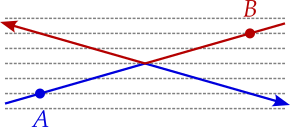
Consider figure 6.1. Particle \(A\) and particle \(B\) both have the same mass and travel at the same speed in opposite directions. Using either formula for momentum, it is clear that momentum is conserved in this frame — indeed, the total momentum is always zero. We assume that the horizontal components of the velocities are considerably greater than the vertical components4
4 Hence the figure is not to scale, but has been stretched vertically for clarity.
Each particle carries a clock. The dashed lines are carefully spaced so that each particle’s clock ticks whenever the particle crosses a line. Note that the clock ticking and the clock crossing the line are simultaneous events at the same location so they will be simultaneous events in any frame of reference. In other words, every observer will agree that the clocks tick as they cross a line.
Now consider the same situation, but viewed by an observer travelling to the right so as to keep alongside particle A. In this observer’s frame, the collision appears as in figure 6.2.
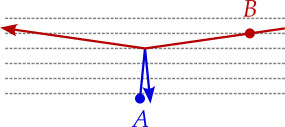
If momentum is to be conserved then, before the collision, the vertical component of \(A\)’s momentum must be equal an opposite to \(B\)’s. Why? Suppose that \(A\) has more momentum upwards than \(B\) has downwards. Then the total momentum is upward. But then, after the collision, the vertical velocity (and hence momentum) of each particle is reversed, with particle \(A\)’s momentum now downward and hence the total momentum being downward. Clearly, momentum would not be conserved if this were the case.
Velocity, however, is a different matter. The vertical component of each particle’s velocity is proportional to the frequency with which each particle crosses the dashed lines and hence proportional to the rate at which each clock ticks. Since particle \(A\) is barely moving, its clock ticks at the usual rate. Particle \(B\), however, is moving rapidly in the horizontal direction and hence its clock is slowed by a factor5 of \(\gamma_B\). Therefore, the vertical component of the velocity of particle \(B\) is smaller than that of \(A\) by a factor of \(\gamma_B\).
5 We will often see situations where objects and frames move at different speeds and where we need to use multiple different Lorentz factors. Hence \(\gamma\) will be subscripted either with the particle label or with the associated speed.
This immediately reveals that momentum cannot be proportional to velocity. Note, though, that if we multiple each velocity by the particles Lorentz factor, then this precisely balances the time dilation so that the vertical components of \(\gamma\mathbf{v}\) for each particle are equal and opposite. Hence, a momentum that is proportional to \(\gamma\mathbf{v}\) is not ruled out and our new formula for momentum is looking good thus far.
What about the direction of the momentum? Both the old and new formulae have momentum pointing in the same direction as the velocity. Is this reasonable? Yes, certainly, but more importantly, all other choices are unreasonable. Given that the universe does not have any special directions6, if the direction of the momentum were, for example, 5 degrees to the right of the velocity, then we would be entitled to ask, why to the right? Why not to the left of the velocity, or above, or in some other direction? Given a single moving particle, the only special direction is that of the velocity of the particle — the momentum must also point that way.
6 I.e. is isotropic.
6.2 Another collision
Let’s look at another collision. This will allow us to practice with conservation of momentum, but will also have a rather surprising outcome.
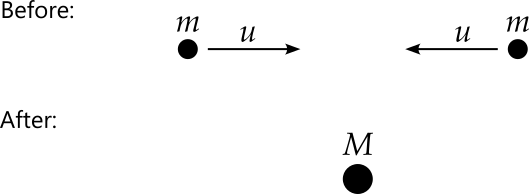
Figure 6.3 shows two particles of identical mass, \(m\), colliding in their centre of mass frame and merging to create a single stationary particle of mass \(M\). In this frame, it is clear that momentum is conserved. What happens if we choose to view the collision from a different frame as in figure 6.4?
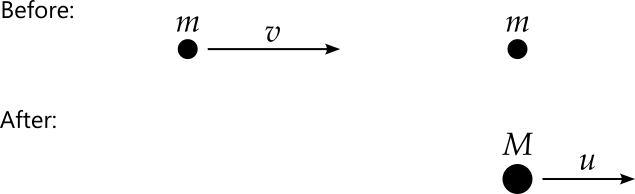
First we calculate the velocity \(v\) using the velocity addition formula. \[ v = \frac{2u}{1 + u^2 / c^2}. \] The associated Lorentz factor is then \[ \gamma_v = \frac{1 + u^2 / c^2}{1 - u^2 / c^2}. \]
Confirm that \(\gamma_v\) really is given by the formula above. (You might wish to simplify the calculation by working in units where \(c = 1\).)
Total momentum before the collision is therefore given by \[ \begin{aligned} p &= \gamma_vmv\\ &= m\frac{1 + u^2 / c^2}{1 - u^2 / c^2}\frac{2u}{1 + u^2 / c^2}\\ &= \frac{2mu}{1 - u^2 / c^2}. \end{aligned} \] while the momentum after the collision is \[ p = \gamma_uMu = \frac{Mu}{\sqrt{1 - u^2 / c^2}}. \] If momentum is conserved, i.e. if these are equal, then we find that \[ M = \frac{2m}{\sqrt{1 - u^2 / c^2}}. \] In other words, by conserving momentum, we show that the total mass must increase.
Given that this is a somewhat unexpected result, we should check what happens in the classical limit of a low energy collision. When \(u\) is small compared with the speed of light, the equation reduces to \(M = 2m\), which is what we expect from everyday experience.
6.3 Conservation of energy
Let’s look at this collision again, but now consider what happens to energy, given our new formula. But first, let’s ask whether we would even expect energy to be conserved. The collision is clearly inelastic. In classical mechanics, we would note that kinetic energy is not conserved but is lost. Of course, we understand that energy, as a whole, is never truly lost, but it has left the realm of mechanics and entered the realm of thermodynamics — the lost kinetic energy can be found in the heat of the merged object.
So, we might not expect our new formula for energy to give a conserved quantity, but let’s examine what happens to the energy anyway. First, we will work in the centre of mass frame. Before the collision, the total energy is simply \[ E_{\text{before}} = 2\gamma_umc^2 = \frac{2mc^2}{\sqrt{1- u^2 / c^2}}. \] After the collision, the total energy is given by \[ E_{\text{after}} = \cancel{\gamma_0}Mc^2 = \frac{2mc^2}{\sqrt{1 - u^2 / c^2}}. \] Perhaps surprisingly, the energy is conserved, even though this is an inelastic collision.
How do we explain this? Kinetic energy is not conserved, so our formula for energy must include other forms of energy too. Let’s take the classical limit, where the velocity \(v\) is small compared to the speed of light, and Taylor expand in \(v/c\). We get \[ E = \gamma mc^2 = \frac{mc^2}{\sqrt{1 - v^2 / c^2}} = mc^2 + \frac{1}{2}mv^2 + \frac{3}{8}\frac{mv^4}{c^2} + \ldots \] The second term is recognisable as the (classical) kinetic energy. The first term, however, is new and represents the ‘mass energy’. In classical mechanics, before special relativity, this term makes no practical, since the total mass is conserved and only differences in energy are meaningful. But we have just seen that, in special relativity, mass need not be conserved. In our inelastic collision, the initial kinetic energy has simply been converted into this ‘mass energy’.
Remark 6.1. Wait a second. When we considered this collision classically, perhaps thinking of the particles as being made of some dough-like substance, we claimed that the kinetic energy was converted into heat, i.e. into the kinetic (and potential) energy of the molecules in the dough. In this sense, the energy is still there and none of it seems to have been converted into mass.
This is true — there are no new dough molecules after the collision. In this microscopic view, the sum of the masses of all the particles is the same as it always was. Zoom out, though, and we can also consider the result to be a single particle of increased mass. It is just that the internal energy is now considered as part of that mass. It is worth noting that the resulting object will also behave as a heavier particle. For example, a hot blob of dough is slightly more difficult to accelerate than a cold blob made of the same constituent parts.
We might also consider the situation where, instead of dough, we have two fundamental particles colliding to create a new fundamental particle. In this case, the resulting particle has no internal energy in the form of heat — it has no constituent parts to excite. In this case, there is no argument — the energy of the collision has been converted into mass.
Check that energy is also conserved when the collision is viewed from the second frame of reference.
It is worth mentioning that, since \(c\) is large, a small mass \(m\) could conceivably be converted into a lot of energy, \(mc^2\). A simple calculation (and some research into lightning) reveals that a kilogram of mass has ‘mass energy’ equivalent to fifty million lightning bolts.
6.4 An important relation and the transformation of energy and momentum
Let’s quickly calculate \(E^2 - \left|\mathbf{p}\right|^2c^2\). \[ \begin{aligned} E^2 - \left|\mathbf{p}\right|^2c^2 &= \gamma^2m^2c^4 - \gamma^2m^2\left|\mathbf{v}\right|^2c^2\\ &= \gamma^2m^2c^4\left(1 - \frac{v^2}{c^2}\right)\\ &= m^2c^4. \end{aligned} \] This equation, relating energy, momentum and mass, is important for solving relativistic collision problems and hence important in particle physics. It is worth highlighting7. \[ \boxed { E^2 - \left|\mathbf{p}\right|^2c^2 = m^2c^4. } \] Note that, for a massless particle, this becomes \[ E = pc. \] (Calculating either momentum or energy for massless particles is not possible using our previous formulae, since \(m = 0\) and \(\gamma = \infty\).)
7 We will see later that it can be convenient to set \(c = 1\), e.g. by choosing appropriate units. This equation then becomes the even simpler looking \[ E^2 - p^2 = m^2. \]
To begin looking at the Lorentz transformation of energy and momentum, let’s start with figure 6.5.
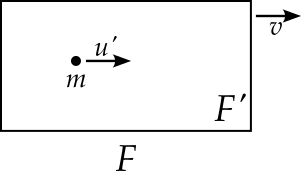
Start by finding the velocity of the particle in frame \(F\) by using the velocity addition formula. We get \[ u = \frac{u' + v}{1 + u'v/c^2}. \] We now simply calculate the energy and momentum in frame \(F\) and compare with that in frame \(F'\). First, note that \[ \gamma_u = \gamma_{u'}\gamma_v\left(1 + u'v / c^2\right) \]
Check the formula for \(\gamma_u\).
\[ \begin{aligned} \gamma_u^2 &= \frac{1}{1 - \left(\frac{u' + v}{1 + u'v/c^2}\right)^2 / c^2}\\ &= \frac{\left(1 + u'v / c^2\right)^2}{\left(1 + u'v / c^2\right)^2 - (u' + v)^2 / c^2}\\ &= \frac{\left(1 + u'v / c^2\right)^2}{1 + u'^2v^2 / c^4 - u'^2 / c^2 - v^2 / c^2}\\ &= \frac{\left(1 + u'v / c^2\right)^2}{\left(1 - u'^2 / c^2\right)\left(1 - v^2 / c^2\right)}\\ &= \gamma_{u'}^2\gamma_{v}^2\left(1 + u'v / c^2\right)^2 \end{aligned} \] and so \[ \gamma_u = \gamma_{u'}\gamma_v\left(1 + u'v / c^2\right). \]
Noting that, in frame \(F'\), \[ E' = \gamma_{u'}mc^2, \qquad p' = \gamma_{u'}mu', \] we find that \[ \begin{aligned} E &= \gamma_umc^2 = \gamma_{u'}\gamma_vm\left(c^2 + u'v\right) = \gamma_v\left(E' + vp'\right),\\ p &= \gamma_umu = \gamma_{u'}\gamma_vm\left(u' + v\right) = \gamma_v\left(p' + vE' / c^2\right). \end{aligned} \] This might already be looking familiar. To complete the job, recall that the Lorentz transformation, in terms of \(ct\) and \(x\), is \[ \begin{aligned} ct &= \gamma\left(ct' + vx' / c\right),\\ x &= \gamma\left(x' + vct' / c\right) \end{aligned} \] while the transformation of energy and momentum can be rephrased as \[ \begin{aligned} E &= \gamma_v\left(E' + vcp' / c\right),\\ cp &= \gamma_v\left(cp' + vE' / c\right). \end{aligned} \] We find that the transformation of \(E\) and \(cp\) is identical to that of \(ct\) and \(x\).
Now recall that, from the Lorentz transformation for \(ct\) and \(x\), it was possible to show that \[ c^2t^2 - x^2 - y^2 - z^2 = c^2t^2 - \left|\mathbf{x}\right|^2 \] is invariant under Lorentz transformation. The same logic must now apply to the combination \[ E^2 - c^2\left|\mathbf{p}\right|^2, \] i.e. this takes the same value in any frame of reference. For a single particle this is telling us little new, since we have already shown that this equals \(m^2c^4\) and we would hope that particle mass is Lorentz invariant8. However, this also holds for a multi-particle system, which is a much more useful result. (It equals the squared energy in the centre-of-mass frame.)
8 Be careful not to confuse the concepts of Lorentz invariance and conservation. The first means that a value does not change when we perform a Lorentz transformation, i.e. when we change frames. The second means that a value does not change over time. Hence energy is conserved, but is not invariant, while mass is invariant but not conserved.
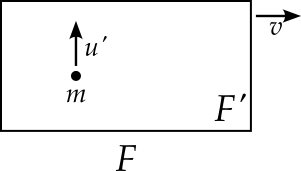
Thus far, we have only really derived the energy and momentum transformation formulae for the case with only one spatial direction. That is, we have assumed that the particle moves in the same direction as the frame. The full transformation, for frames travelling relative to each other in the \(x\)-direction, is given by \[ \begin{aligned} E &= \gamma_v\left(E' + vcp_x' / c\right),\\ cp_x &= \gamma_v\left(cp_x' + vE' / c\right),\\ cp_y &= cp_y',\\ cp_z &= cp_z'. \end{aligned} \] Show that these equations hold when the particle moves vertically within frame \(F'\), i.e. as shown in figure 6.6.
6.5 Newton’s laws and forces
We finally return to Newton’s laws. The first law — that a body remains at rest or in motion at constant speed in a straight line, unless acted on by a force — can be kept as is. Indeed, it is how we have defined inertial frames. The second and third laws, however, require us to define force.
Our first guess might be to define the force to be mass times acceleration. Alas, a moment’s thought should suggest that this will not work9, since this would imply that, given time, a force could accelerate an object to go faster than the speed of light. Perhaps then we might guess that we should multiply this by \(\gamma\), but even then this is not the correct answer.
9 Note that even in classical mechanics, \(F = ma\) only works when \(m\) is constant.
Instead, we must return to the original formulation of Newton’s second law and define \[ F = \frac{dp}{dt}. \] We then find that \[ F = \frac{d}{dt}\gamma mv = mv\frac{d\gamma}{dt} + \gamma ma, \] where \(a\) is the acceleration. We also have \[ \begin{aligned} \frac{d\gamma}{dt} &= \frac{d}{dt}\frac{1}{\sqrt{1 - v^2 / c^2}}\\ &= \left(\frac{-2av}{c^2}\right)\left(\frac{-1}{2\sqrt{1 - v^2 / c^2}^3}\right)\\ &= \frac{av\gamma^3}{c^2}. \end{aligned} \] Combining these results, we get \[ \begin{aligned} F &= \frac{mav^2\gamma^3}{c^2} + \gamma ma = \gamma ma\left(\frac{v^2\gamma^2}{c^2} + 1\right)\\ &= \gamma ma\left(\frac{v^2}{c^2 - v^2} + 1\right) = \gamma ma\left(\frac{1}{1 - v^2 / c^2}\right)\\ &= \gamma^3ma. \end{aligned} \] Defining force in this way has the additional advantage that conservation of momentum now implies Newton’s third law, without modification. Given any two particle system, conservation of momentum implies that the rate of change of momentum of one particle must be counterbalanced by the rate of change of momentum of the second and hence, since we have defined force to be the rate of change of momentum, the force particle \(A\) exerts on particle \(B\) must be equal and opposite to the force \(B\) exerts on \(A\).
We can also explore the relationship between force and energy, given the new definitions. Consider the energy of a particle being accelerated by a force, in one dimension. Then \[ \begin{aligned} \frac{dE}{dx} &= \frac{d}{dx}\left(\gamma mc^2\right)\\ &= mc^2\frac{d}{dx}\frac{1}{\sqrt{1 - v^2 / c^2}}\\ &= m\cancel{c^2}\frac{v dv/dx}{\cancel{c^2}\sqrt{1 - v^2 / c^2}^3}\\ &= \gamma^3mv\frac{dv}{dx} = \gamma^3m\frac{dx}{dt}\frac{dv}{dx}\\ &= \gamma^3m\frac{dv}{dt} = \gamma^3ma = F, \end{aligned} \] or equivalently \[ E = \int F\,dx. \] In other works, we get the same relationship between force and work as in classical mechanics.