Hyperbolic functions
if you have studied complex numbers, you will be familiar with Euler’s formula \[ e^{i\theta} = \cos\theta + i\sin\theta. \] Combining this with the formula for \(e^{-i\theta}\) and rearranging, it is easily shown that \[ \begin{aligned} \cos\theta &= \frac{e^{i\theta} + e^{-i\theta}}{2},\\ \sin\theta &= \frac{e^{i\theta} - e^{-i\theta}}{2i}. \end{aligned} \]
The hyperbolic functions, \(\cosh x\) and \(\sinh x\) are what we get if we remove all \(i\)’s from these formulae, i.e. \[ \begin{aligned} \cosh x &= \frac{e^x + e^{-x}}{2},\\ \sinh x &= \frac{e^x - e^{-x}}{2}. \end{aligned} \]
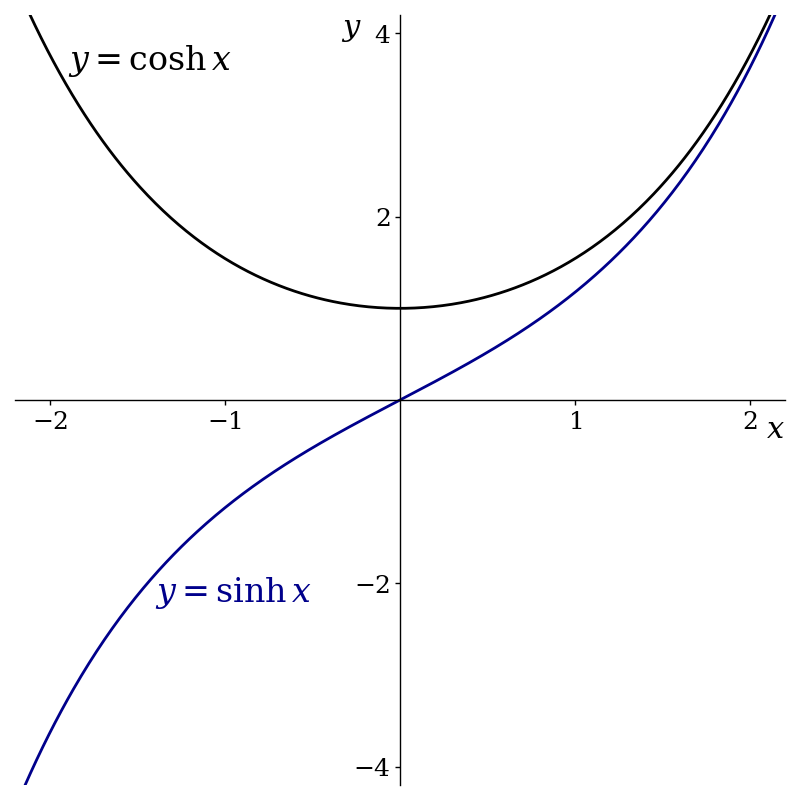
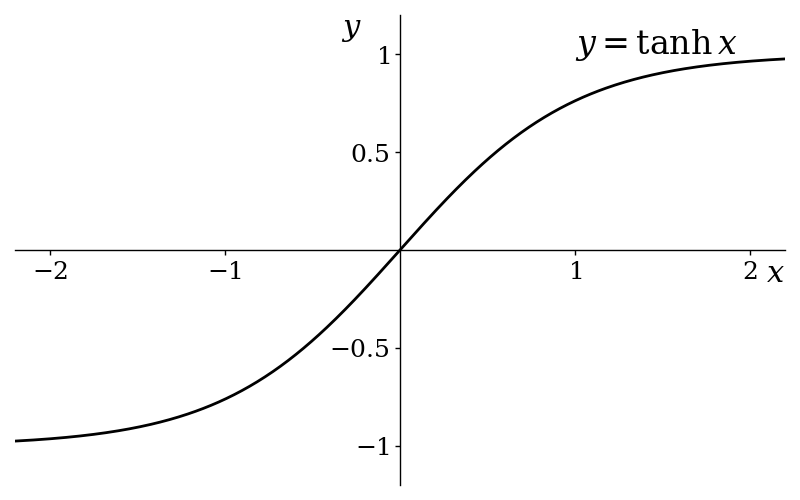
As you might expect, we also define \[ \tanh x = \frac{\sinh x}{\cosh x} = \frac{e^x - e^{-x}}{e^x + e^{-x}}, \] analogous to the definition of the tangent1.
1 We may, of course, also define \(\mathop{\mathrm{sech}}x\), \(\mathop{\mathrm{cosech}}x\) and \(\coth x\).
Relationship with trigonometric functions
The hyperbolic sine and cosine can be thought of as the result of applying trigonometric functions to imaginary angles. We find that \[ \begin{aligned} \cosh x &= \cos ix,\\ \sinh x &= i \sin ix. \end{aligned} \]
Hyperbolic function equalities
For each equality satisfied by the trigonometric functions, we can usually find an analogous equality for the hyperbolic functions. The following equalities should all look vaguely familiar2. \[ \begin{gather*} \cosh^2 x - \sinh^2 x = 1,\\ \sinh(x + y) = \sinh x\cosh y + \cosh x\sinh y,\\ \cosh(x + y) = \cosh x\cosh y + \sinh x\sinh y,\\ \tanh(x + y) = \frac{\tanh x + \tanh y}{1 + \tanh x \tanh y},\\ \mathop{\mathrm{sech}}^2x = 1 - \tanh^2x,\\ \text{etc.} \end{gather*} \]
2 These are almost identical to the analogous trigonometric identities. The notable difference is that wherever there is a produce of hyperbolic sines (or tangents), a minus sign is introduced.
Using the definitions of the hyperbolic functions, check that each of these identities is true.
I will provide the deriviation of just the first identity. We have \[ \begin{aligned} \cosh^2x - \sinh^2x &= \frac{\left(e^x + e^{-x}\right)^2}{4}-\frac{\left(e^x - e^{-x}\right)^2}{4}\\ &= \frac{\left(e^{2x} + 2 + e^{-2x}\right) - \left(e^{2x} - 2 + e^{-2x}\right)}{4}\\ &= \frac{4}{4} = 1. \end{aligned} \]
Hyperbolic function dervatives
We are unlikely to need to differentiate the hyperbolic functions in this course. However, for completeness we have \[ \frac{d}{dx}\cosh x = \sinh x, \qquad \frac{d}{dx}\sinh x = \cosh x. \]
Check these derivatives, using the definitions of \(\sinh x\) and \(\cosh x\).