3 The postulates and their effects on time and space
3.1 The postulates
Special relativity is derived from two postulates:
- The laws of physics are the same in any inertial frame — the principle of relativity.
- The speed of light (in a vacuum) is the same in any inertial frame.
The first of these postulates should seem reasonable to you. The second, though supported by plentiful evidence, should seem strange.
Think about what this second postulate implies. Now consider the following scenario. The speed of light in a vacuum is approximately 300,000 km/s. A source emits a pulse of light and you measure its speed as it passes and record 300,000 km/s as expected. The source then emits a second pulse of light, but as it passes, you get in your spaceship and chase it at a speed of 200,000 km/s. How quickly does the light pulse recede from you, in your frame of reference?
In your new frame of reference, the light pulse will still travel at 300,000 km/s. It doesn’t matter how quickly you travel in your spaceship, you will always observe that the light pulse recedes from you at 300,000 km/s. What if you left a friend behind when you boarded your spaceship - how fast does she observe this same light pulse to move? In her frame of reference, the light still travels at 300,000 km/s!
We will quickly tire of writing 300,000 km/s. It is therefore common practice to write \(c\) for the speed of light.
What might we expect when we build a theory upon such a counter-intuitive supposition? Some counter-intuitive results, of course!1 However, I do wish to emphasise that, once we get to the end of this course, you will have seen a self-consistent and rational theory — it is just that the results are not those that might be suggested by your ‘common sense’.
1 You have likely heard of the computing aphorism “garbage in, garbage out”. Here we have “weird in, weird out”.
3.2 Simultaneity
Consider the following thought experiment. There are two observers, one standing on a station platform, with the other on board a train moving through the station at constant velocity. A light source is set up at the centre of the train carriage, which emits a light pulse in all directions. Each observer notes when the light reaches each end of the carriage. Figure figure 3.1 shows the setup in the reference frame of the passenger.
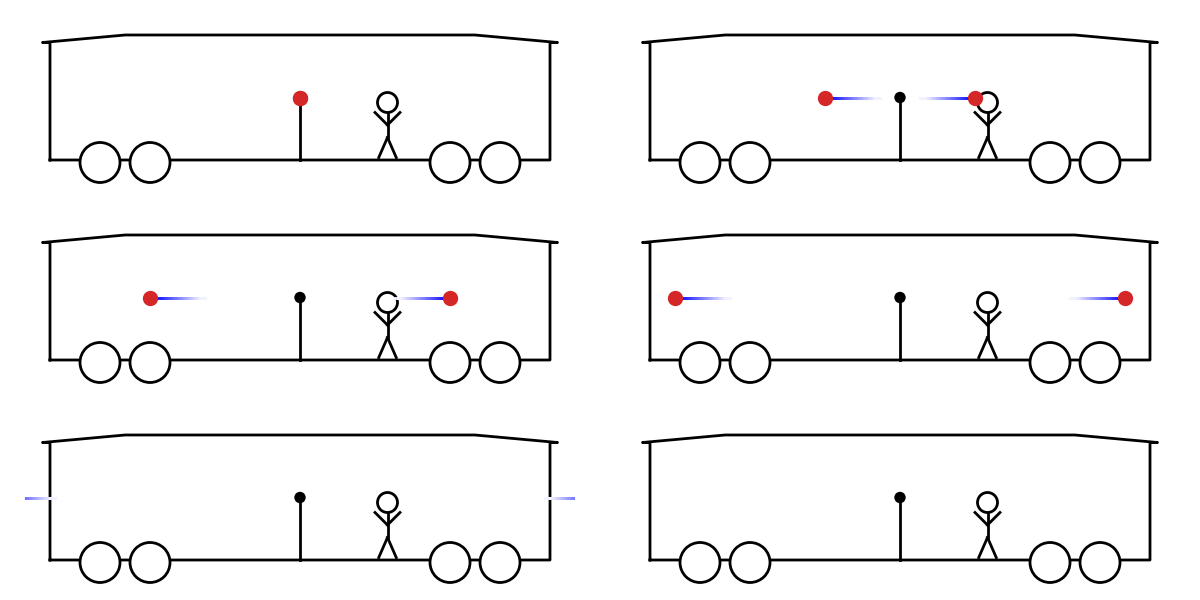
In her frame of reference, the light travels at the same speed in each direction. It reaches each end of the carriage simultaneously, since the light source is equidistant from each end.
Now let us consider the situation in the frame of the observer on the platform.

In his frame of reference, the light also travels at the same speed in each direction. However, the rear of the carriage moves towards the point where the light was emitted, shortening the distance the light needs to travel, while the front of the carriage moves further from the point of emission. Hence, the light reaches the rear of the carriage first, since it does not have so far to travel.
This demonstrates the relativity of simultaneity — events that are simultaneous in one frame may not be in another. Indeed, if two spatially separated events, \(A\) and \(B\), are simultaneous in one frame of reference, then we can always find both a frame where \(A\) occurs before \(B\) and another where \(B\) occurs before \(A\).
For the thought experiment above, find an inertial frame in which the light moving to the right hits the end of the carriage first.
Remark 3.1 (Consistency in special relativity). We will find that different observers may disagree on values for so many quantities — time, duration, length, volume, energy, momentum, force, etc. — that you may begin to wonder whether observers can agree on anything. We will see some quantities with values that all observers agree upon later. For now, however, I wish to highlight that if two events are simultaneous and occur at the same location, then all observers will agree to this fact.
Suppose this were not the case. Suppose also that, in my frame, my foot arrives at location \(X\) at the same time as a football also arrives at \(X\). Then, in my frame of reference, my foot connects with the ball, a goal is scored and England win the world cup. Hurrah! Now suppose that these events are not simultaneous in your frame. Then, in your frame of reference, my foot misses the ball, another opportunity passes and England lose on penalties. Ah well.
This is clearly nonsense. Special relativity is not science fiction and has nothing to do with alternative realities. We require special relativity to be consistent, in that observers must agree on which events happen2 and which do not. We therefore deduce that observers must agree to the simultaneity of my foot arriving at \(X\) and the ball arriving at the same location.
2 Though they may disagree on the sequence of spatially separated events.
3 Ignoring the possibility of frames that move faster than light.
Observers will also agree3 that, if event \(A\) causes event \(B\), then \(A\) precedes \(B\), i.e. cause precedes effect.
3.2.1 Synchronised clocks and our first relativistic calculation
Now suppose that the passenger on the train has two synchronised (in her frame) clocks that she places at each end of the carriage. Being synchronised, each clock has the same reading, e.g. 10 nanoseconds, when the light reaches them.4
4 If it helps, we can think of the clocks as being light-sensitive stopwatches, so that the light stops the clock.
Now look at the same situation from the frame of the man on the platform. He agrees that each clock reads 10 nanoseconds when the light hits it. But this means that the clock at the rear of the carriage must read 10 nanoseconds before the clock at the front. In other words, the clock at the rear is ahead of the one at the front.
How far ahead is the clock at the rear of the carriage? To work this out, we will move the light source so that the light pulses reach each end of the carriage simultaneously in the platform frame.
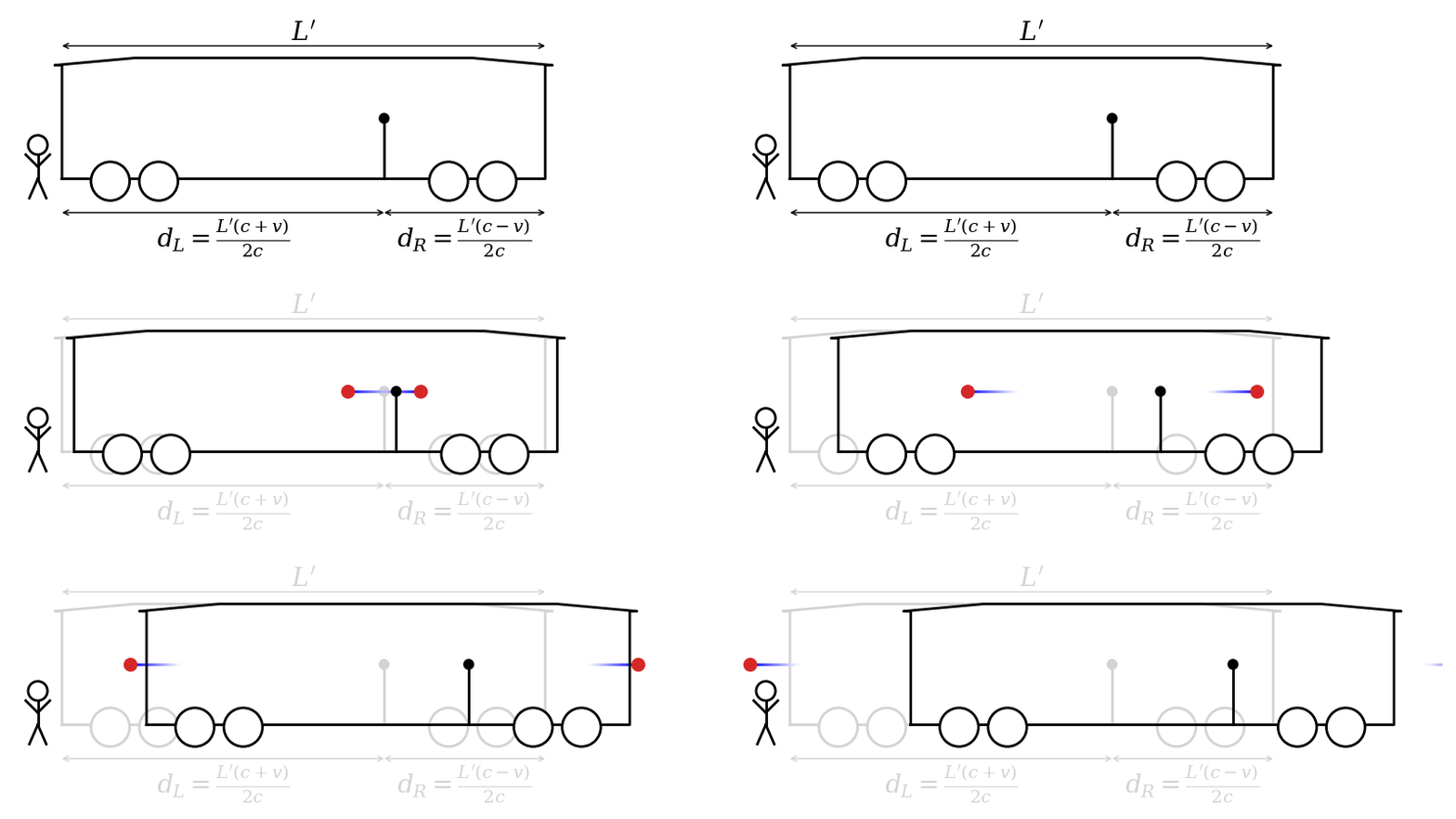 In the platform frame, let the distances from the light emitter to the left and right ends of the carriage be \(d_L\) and \(d_R\) respectively. The photon moving to the left travels at speed \(c\), while the rear of the carriage also approaches at speed \(v\), giving a relative speed5 of \(c + v\). The time taken for the light to reach the rear of the carriage is therefore \(t_L = d_L / (c + v)\). Meanwhile, the photon moving to the right travels at \(c\) while the front of the carriage moves away at speed \(v\), giving a relative speed of \(c - v\). The light therefore takes \(t_R = d_R / (c - v)\) to reach the front of the carriage. We want these times to be equal, while \(d_L\) and \(d_R\) must sum to the length of the carriage, i.e.
5 It is legitimate to use relative velocities and these can be greater than \(c\). This is fine, since no object travels faster than \(c\). However, this relative velocity is not the same as the velocity of the photon in the carriage reference frame. (If using relative velocities makes you uncomfortable, confirm that the photons reach the ends of the carriage simultaneously by calculating the positions of the ends of the carriage and both photons after time \(L'/(2c)\), given the distances shown.)
\[ d_L + d_R = L'\qquad \text{and} \qquad \frac{d_L}{c + v} = \frac{d_R}{c - v}. \] Solving these equations for \(d_L\) and \(d_R\), we find that \[ d_L = \frac{L'(c + v)}{2c},\qquad d_R = \frac{L'(c - v)}{2c}. \]
We now examine the situation in the frame of the passenger.
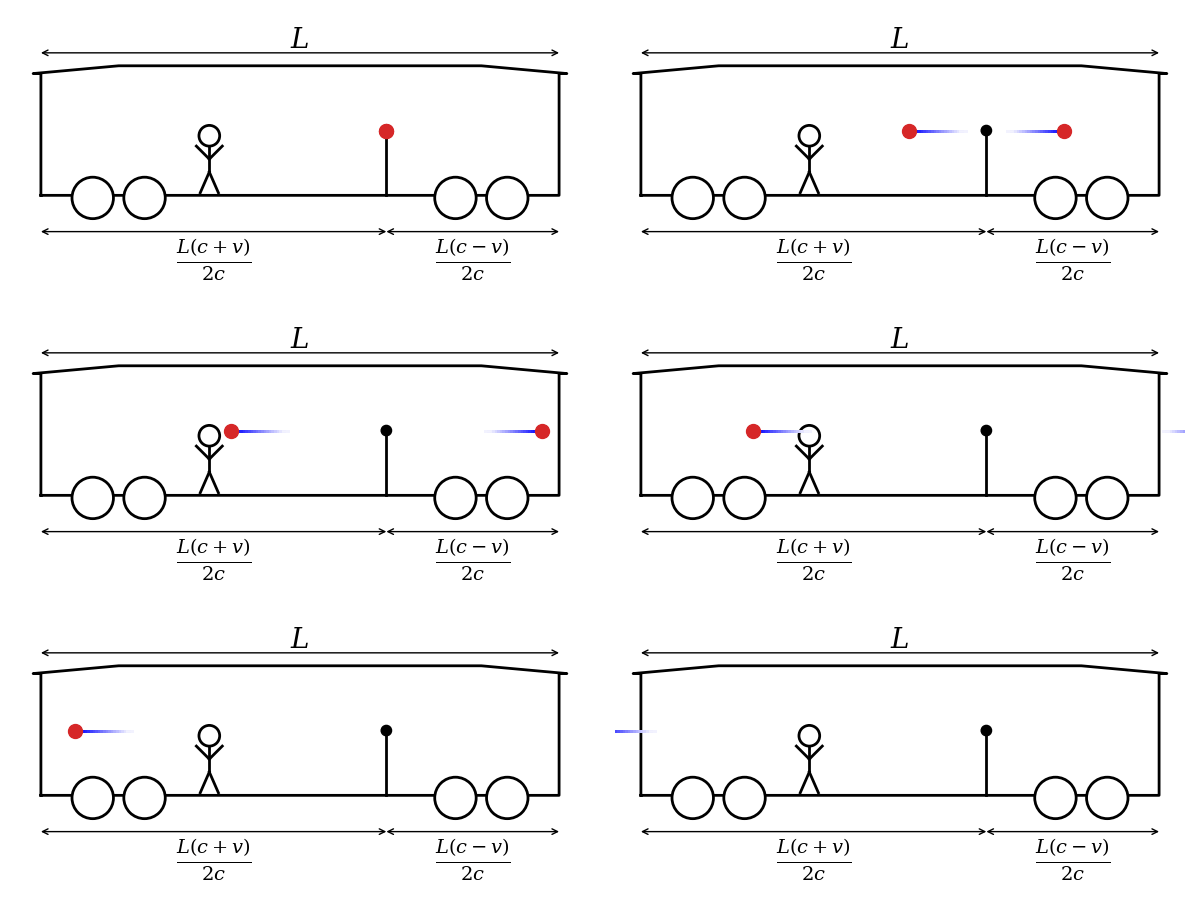
Since we are not sure that the length of the carriage is the same in both frames6, the length is given as \(L\) rather than \(L'\). However, it is reasonable to assume that all the lengths given in the diagram are contracted (or lengthened) by the same factor. We see that the light pulse travelling to the left takes longer to reach the end of the carriage. How much longer? \[ \Delta t = \frac{L(c + v) / 2c - L(c - v) / 2c}{c} = \frac{Lv}{c^2}. \] So, if the passenger has set up synchronised clocks at each end of the carriage, the time displayed by the left clock as the light pulse passes is \(Lv/c^2\) greater than that shown earlier by the right clock as the light pulse passed it. In the platform frame, these two events are simultaneous, so the left clock is ahead of the right clock by \(Lv/c^2\), where \(L\) is the length of the carriage in the passenger’s frame of reference.
6 Indeed, we will see later that moving objects are contracted in the direction of travel.
3.3 Light clocks and time dilation
We continue our thought experiments by considering a light clock. This consists of two parallel mirrors with a photon bouncing between them. Each time the photon bounces from the bottom mirror, the clock ‘ticks’.7
7 Don’t worry about how the photon is detected, to enable the clock to ‘tick’. This is, after all, a thought experiment.

Let \(t_C\) be the time between ticks, in the clock’s frame of reference. Then the distance between the mirrors must be \[ h = \frac{1}{2}ct_C. \] We now place the clock on the train, travelling at velocity \(v\), arranged so that the mirrors are horizontal. Let’s consider the clock in each of the observers’ frames.
First, the passenger on the train is in the clock’s frame — in her frame, the clock therefore takes \(t_C\) between ticks.
Now consider the clock in the frame of the man on the platform. The clock is moving horizontally, so the photon also now has a horizontal component to its motion.
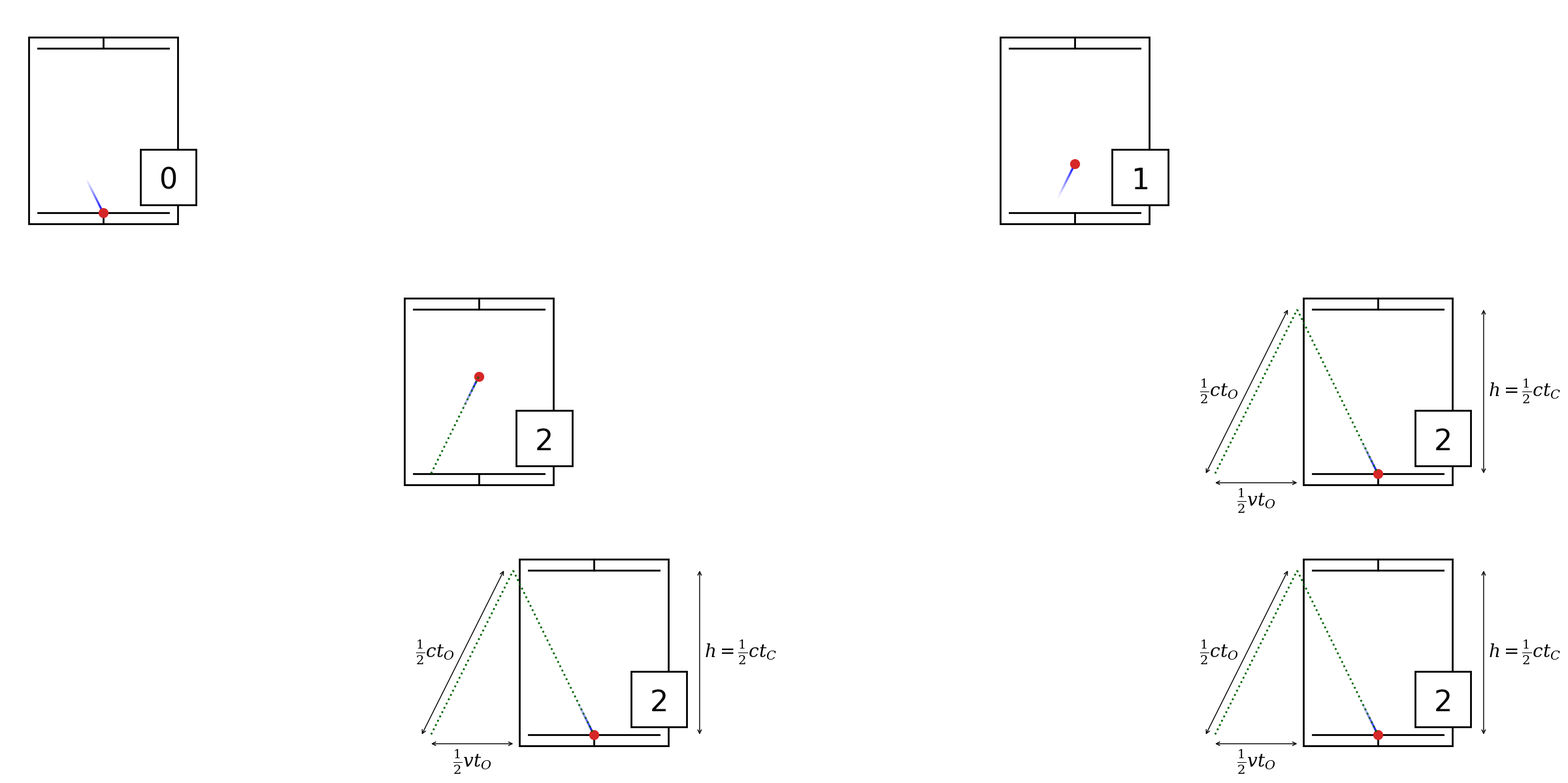
If the time between ticks is \(t_O\) then we know that the distance travelled by the photon is \(ct_O\) between ticks, or \(\frac{1}{2}ct_O\) between leaving the lower mirror and reaching the upper one. During this time, the photon moves \(\frac{1}{2}vt_O\) horizontally in order to keep pace with the mirrors. We will furthermore assume that the distance between the mirrors is unaffected by the motion8, so this remains \(\frac{1}{2}ct_C\).
8 Given that the next section of these notes concerns length contraction, it is not immediately obvious that the height of the clock should be the same in each frame. This will be the topic of one of the exercises. Note that this is why the clock must be placed upright on the train, with mirrors horizontal — if we placed it on its side we would get a more complicated situation where both time dilation and length contraction occur. We will see this later.
We now apply Pythagorous’ theorem to get \[ c^2t_O^2 = c^2t_C^2 + v^2t_O^2 \] which we rearrange to get \[ t_O^2 = \frac{c^2t_C^2}{c^2 - v^2} \] and hence \[ t_0 = \gamma t_C \] where \[ \gamma = \frac{1}{\sqrt{1 - v^2/c^2}}. \] (We will see this factor of \(\gamma\) again and again — it is worth memorising.)
What does this mean? It means that, for the man on the platform, the clock on the train runs slow because the light9 has further to travel.
9 Which always travels at the same speed.
10 We cannot have the passenger contracting salmonella in one frame of reference and not in the other!
Is it just light clocks that run slow? No! Imagine that the passenger, standing next to the clock, is boiling an egg, using the clock to decide when to stop cooking. After five minutes they extract and eat a perfectly soft-boiled egg. But for the man on the platform, the clock runs slower and hence the egg is cooked for longer. Does this mean that, in his reference frame, the passenger eats a hard-boiled egg. No! We require some consistency between events in the two frames10. The only answer is that the egg must cook more slowly. The same applies to any other process taking place on the train. From the platform frame of reference, all such processes run more slowly — a cuckoo clock will run slow, the passengers heart rate will be lower, the passenger will age more slowly. For the man on the platform, time runs more slowly on the train.
3.3.1 A clock on the platform
Now suppose that in addition to the light clock on the train (which we shall call \(T\)), we place a light clock on the platform (\(P\)). We have already seen that in the platform frame, this clock runs faster than the clock on the train. So \(P\) is faster than \(T\). What happens in the frame of the passenger on the train?
In this frame, it is the clock on the train that is stationary and the one on the platform that is moving. Hence \(P\) runs slower than \(T\).
Wait a minute! We have just said that \(P\) runs more slowly than \(T\) and \(T\) runs more slowly than \(P\). Surely this is a contradiction. Actually, it isn’t. The solution here is to consider how we should react to the statement “clock \(P\) runs more slowly than clock \(T\)”. In everyday conversation, an appropriate response is “ok, thank you for letting me know”. In special relativity, the correct response is to ask “in which frame of reference?”. When we find that clock \(P\) is slower in the frame of the train and that clock \(T\) is slower in the frame of the platform then the contradiction vanishes, since time is different in the two frames. The passenger on the train and the man on the platform are measuring different things.
Example 3.1 (The twin paradox) There are two twenty-year-old identical twins that nobody can tell apart. Twin A travels aboard a spaceship to Altair, 16.7 light years away, and back at a speed of \(0.99c\). Twin B remains on Earth.
In the frame of twin B, twin A returns approximately 33.7 years later. Naturally, twin B is now 53 years old. But due to time dilation, twin A has only aged about 4.8 years. Now nobody has any difficulties telling the twins apart.
Confirm the ages of the travelling twin after the trip, using what you have learned about time dilation.
Thus far, there is no paradox11. However, someone might argue that, in the frame of twin A, it is twin B12 that travels 16.7 light years out and 16.7 light years back. Hence, in this frame, it is twin B that ages slowly, so that when they meet again, twin B will be the younger. This clearly is contradictory.
11 It might seem strange, but there is nothing contradictory here.
12 And Earth and the rest of the solar system.
Identify what is wrong with this argument.
The short answer is that twin A is not in an inertial frame, so we cannot use this reasoning.
You might not find that entirely satisfactory, so I will provide a little more detail. The argument is correct for the outward journey — for this part of the journey, A is in an inertial frame and in this frame, B will age less. It is also correct for the return journey — in A’s new frame, B will still age more slowly. But notice that A switched frames and the argument above fails to consider what happens when this happened.
Alternatively, in practice, turning around at Altair requires A to accelerate and special relativity does not handle accelerating frames of reference.
(Some people might suggest that, to work out what happens in A’s ‘frame’, we would need general relativity. This is not the case — special relativity is sufficient, but a slightly more sophisticated approach is required.)
3.4 Length contraction
Oh no, the clock has fallen over! In the clock’s frame, this makes no difference to the time taken between ticks. That is, it takes \[ t_C = \frac{2w_C}{c}. \]
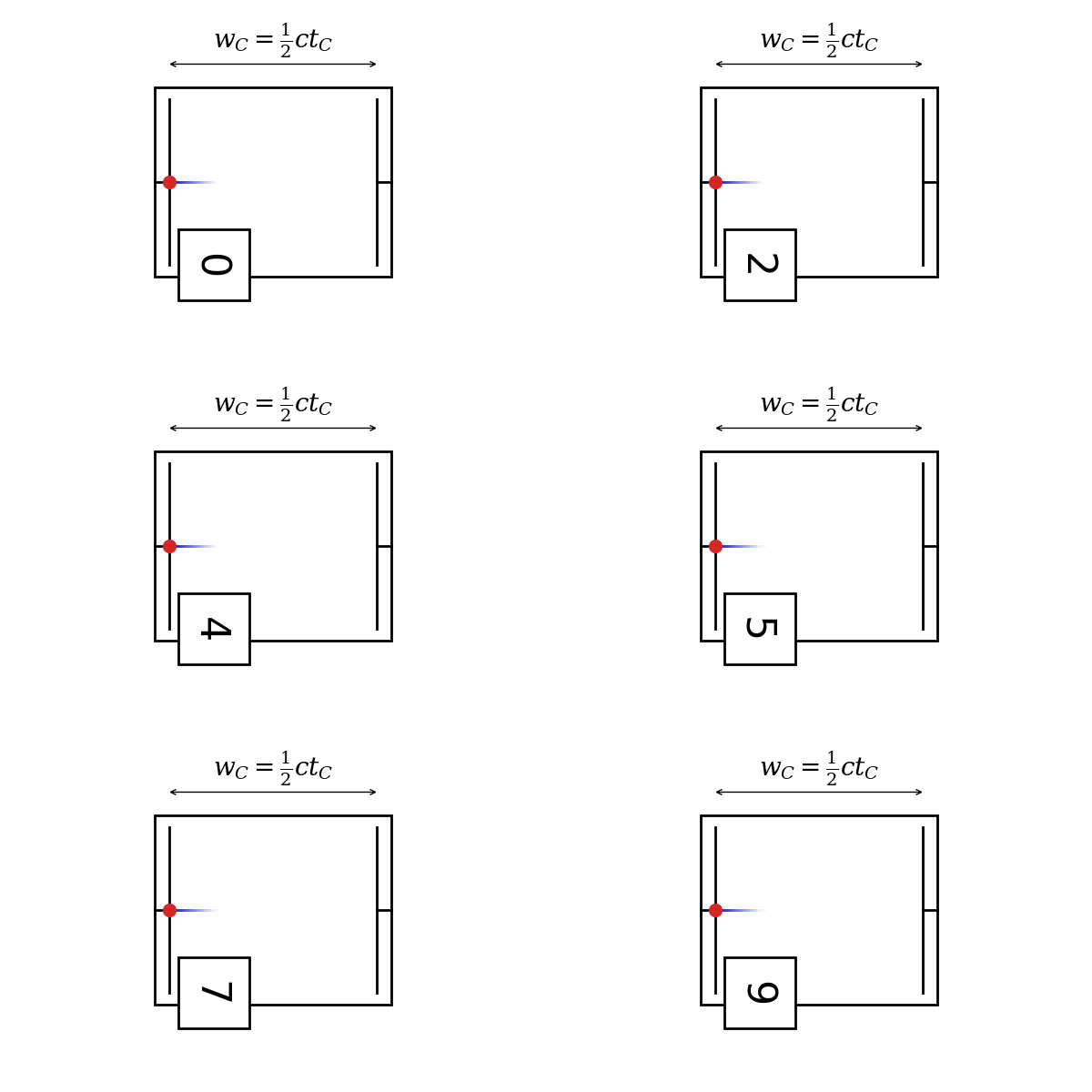
Again, we place the clock on the train travelling at \(v\) and consider the situation in the platform frame.
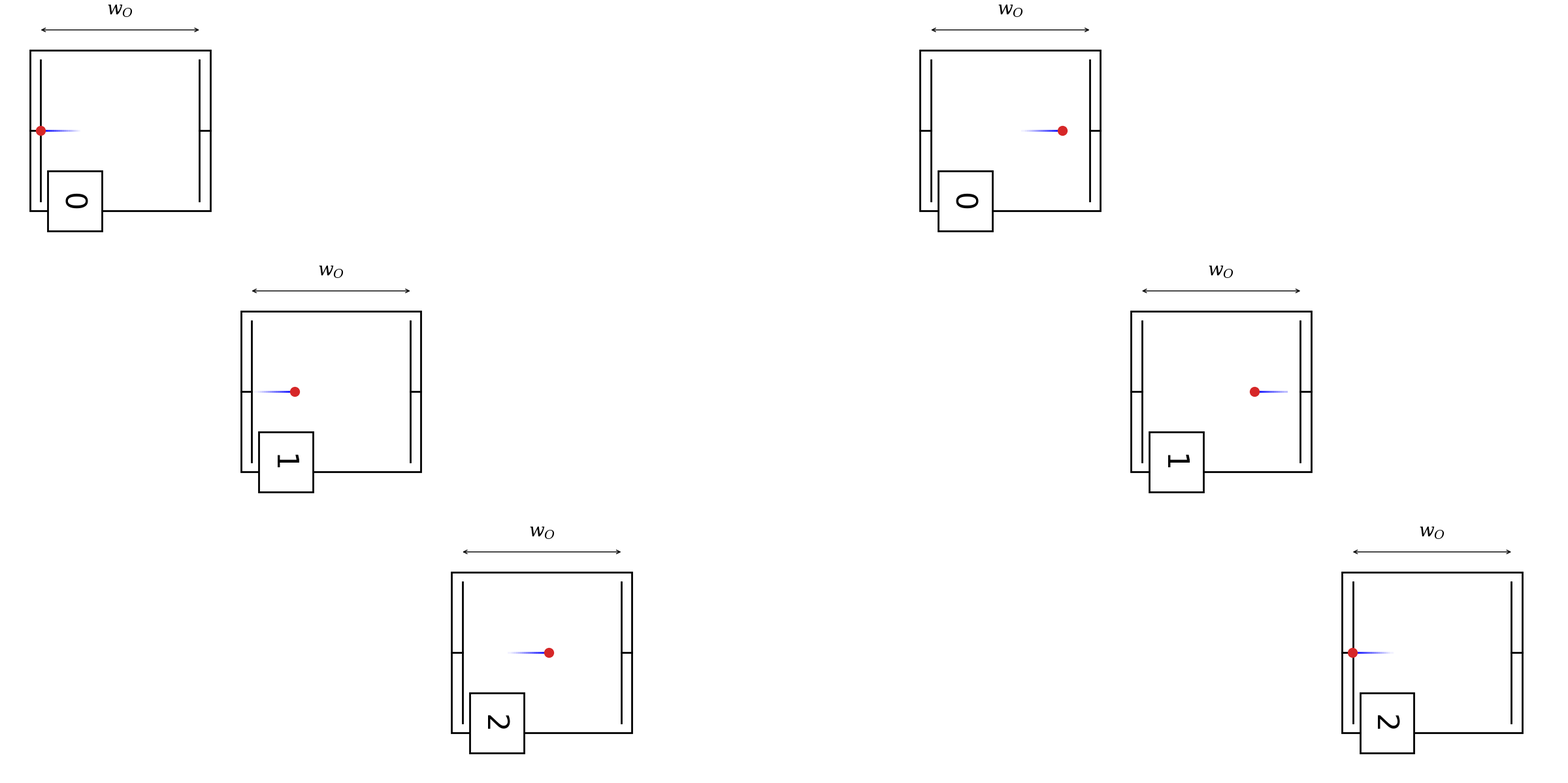
First notice that this time we allow for the possibility that the width of the light clock is different in the two frames. That is, we set the distance between the two mirrors to be \(w_O\) rather than \(w_C\). Now, when the photon is moving to the right at speed \(c\), the right hand mirror recedes at speed \(v\). Hence the time taken for the photon to move from the left mirror to the right is \[ \frac{w_O}{c - v}. \] When the photon moves to the left, the left hand mirror approaches at speed \(v\) and so the time take to go from right to left is \[ \frac{w_O}{c + v}. \] (Here, \(c - v\) and \(c + v\) is the relative velocity13 of the light with respect to the mirror.) The total time between clock ticks is therefore \[ t_O = \frac{w_O}{c - v} + \frac{w_O}{c + v} = \frac{2w_Oc}{c^2 - v^2} = \frac{2w_O\gamma^2}{c}. \]
13 Again, it is perfectly legitimate to use relative velocities, but it is essential that we distinguish between the relative speed of the light and mirror in my frame of reference and the speed of the light in the mirror’s frame of references.
But we can work out how long it takes between ticks using our time dilation formula. \[ t_O = \gamma t_C = \frac{2w_C\gamma}{c} \] Comparing the two results, we see that \[ w_O = \frac{w_C}{\gamma}. \]
We have therefore shown that the length of the moving clock, in the platform frame, is reduced by a factor of \(\gamma\). As with time dilation, it is not just the light clock that is affected — all objects on the train are contracted. For example, the length of the train carriage itself is reduced by a factor of \(\gamma\). This is naturally referred to as length contraction.
3.4.1 An object on the platform
Again, we can consider how an object on the station platform appears to an observer in the train. She will observe that the items on the train, which is stationary in her frame of reference, are their usual lengths, while it is the object on the platform14 that is shortened. Again, this is not a contradiction. If someone tells you that item \(A\) is shorter than item \(B\), you need to ask — “in what frame of reference?”
14 And indeed, the platform itself.
Example 3.2 (Muon decay) When cosmic rays hit the Earth, they result in the creation of fast moving muons high in the atmosphere. However, muons decay rapidly, with a half-life of only 2 microseconds. We might erroneously conclude that very few muons reach the Earth’s surface, since even light travels only about 600 metres in 2 microseconds. Yet we detect many more muons at the Earth’s surface than this would lead us to expect. What is going on?
The key here is to note that the provided half-life of a muon is given in the muon’s frame, while the thickness of the atmosphere is given in our frame. Let’s consider a muon created at a height of 10km, travelling at 0.999c and let’s assume that this muon decays in exactly 0.2 microseconds (in its frame).
Observers frame: In our frame of reference, time passes more slowly for the muon, due to time dilation. This increases its lifetime in our frame. Calculating the Lorentz factor, \(\gamma\), we get \[ \gamma = \frac{1}{\sqrt{1 - 0.999^2}} = 22.37, \] and so in our frame of reference, the lifetime of the muon is now closer to 45 microseconds. While the muon could only travel 599m in 2 microseconds, in 45 microseconds it will travel more than 13 km — enough to reach the surface.
Muon’s frame: In the muons frame, it only survives 2 microseconds, so how does it reach the surface? It does so because the atmosphere15 is length contracted by a factor of \(\gamma\). Therefore, it need only travel a distance of \(10\text{km} / \gamma = 447\text{m}\), which it can manage within its short lifetime.
15 And the rest of the Earth, the solar system…