4 The Lorentz Transformation
4.1 Events
An ‘event’ is something that has a specific time and a specific location in space. For example, a star going supernova is an event, as is a butterfly landing on a leaf. In other words, it is something to which we can ascribe coordinates, \(t\), \(x\), \(y\) and \(z\).
More abstractly, an event can be thought of as just a location in a 4-dimensional spacetime, in the same way that a position is just a location in 3 dimensions.
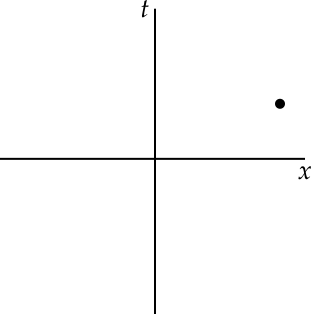
It might be tempting to even think of an event as being the coordinates, but this would be a mistake. Different observers in different inertial frames will assign different sets of coordinate values to the same event, in much the same way that a rotated observer might ascribe different coordinate values to a point on the plane. We can, however, work out how to transform the coordinates, \(t\), \(x\), \(y\) and \(z\) of an event in one inertial frame, \(F\), into the coordinates \(t'\), \(x'\), \(y'\) and \(z'\) in a second frame, \(F'\). This is known as the Lorentz transformation and is the relativistic version of the Galilean transformation seen earlier.
4.2 Derivation
The Lorentz transformation can be derived in a number of different ways. In these notes, we will exploit the results of the previous chapter — time dilation, length contraction and the out-of-sync clocks. In the exercises, you will explore an alternative derivation.
For simplicity, we will assume that the axes of the two frames are aligned in the same directions and that the relative motion of the frames is entirely in the \(x\) (or \(x'\)) direction. We also assume that the origins of the two frames coincide when \(t = t' = 0\).
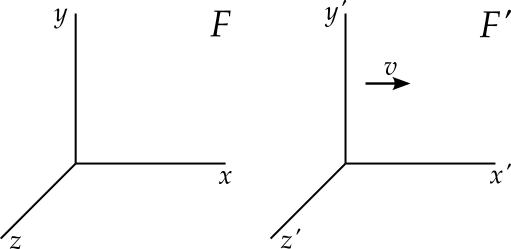
Considerations of symmetry suggest that \(y = y'\) and \(z = z'\). However, we have seen that it would be unsafe to assume that \(t = t'\). We will, however, assume that the transformation takes a relatively simple form. That is \[ \begin{aligned} t &= At' + Bx',\\ x &= Cx' + Dt',\\ y &= y',\\ z &= z', \end{aligned} \tag{4.1}\] where \(A\), \(B\), \(C\) and \(D\) will likely depend on \(v\) but are independent of the coordinates. In other words, we assume that \(t\) and \(x\) depend linearly on \(t'\) and \(x'\)1. We can use the effects of the previous chapter to determine values for \(A\), \(B\), \(C\) and \(D\).
1 A linear relationship ensures that if we double both \(t'\) and \(x'\), then this results in a doubling of \(t\) and \(x\), which should make sense.
4.2.1 Effect 1: Time dilation
We can use time dilation to show that if \(x' = 0\), then \(t = \gamma t'\). To see this, imagine a clock carried along with the origin of frame \(F'\) measuring the time in that frame. Due to time dilation, it will run slower in frame F, since it is moving in that frame. Hence the clock reaches \(t'\) only when \(t = \gamma t'\) has passed in frame F.
4.2.2 Effect 2: Length contraction
We use length contraction to show that if \(t' = 0\) then \(x' = x/\gamma\). Imagine a stick, lying stationary in frame \(F\) along the x-axis between the origin and \(x\). (Assume that \(x > 0\), so that I can discuss the left and right ends.) Now consider the stick in frame \(F'\) at time \(t' = 0\). The left end of the stick is at the origin of the \(F'\) frame, since the origins coincide at this time. If the right end of the stick is at \(x'\) then the length of the stick in frame \(F'\) is \(x'\) and this should equal \(x/\gamma\) by length contraction.
4.2.3 Effect 3: Velocity
This is the simple one — if \(x = 0\) then it must be the case that \(x' = -vt'\).
4.2.4 Effect 4: Rear clock ahead
Imagine a train placed along the \(x'\) axis, travelling with frame \(F'\). The left end of the carriage is placed at \(x' = 0\). Clocks are placed at each end of the carriage, synchronised in the \(f'\) frame and reading zero at \(t'=0\). Now examine the situation from frame \(F\). At time \(t = 0\), the left clock reads zero, while the right clock reads \(t' = -vx'/c^2\), since it is the rear (left) clock that is ahead.
4.2.5 Finding \(A\), \(B\), \(C\) and \(D\)
The four effects have given us four facts that we can use to find \(A\), \(B\), \(C\) and \(D\).
| Effect | Condition | Result |
|---|---|---|
| Time dilation | \(x' = 0\) | \(t = \gamma t'\) |
| Length contraction | \(t' = 0\) | \(x' = x/\gamma\) |
| Relative \(v\) of frames | \(x = 0\) | \(x'=-vt'\) |
| Rear clock ahead | \(t = 0\) | \(t'= -vx/c^2\) |
Substituting into (equation 4.1), we find that
- time dilation gives us \(A = \gamma\),
- length contraction gives us \(C = \gamma\),
- relative velocities gives us \(0 = -Cvt' + Dt'\) and hence \(D = \gamma v\),
- rear clock ahead give us \(0 = -Avx'/c^2 + Bx'\) and hence \(B = \gamma v/c^2\).
The Lorentz transformation has become \[ \boxed { \begin{array}{cc} \begin{aligned} t &= \gamma\left(t' + vx'/c^2\right),\\ x &= \gamma\left(x' + vt'\right),\\ y &= y',\\ z &= z'. \end{aligned} & \qquad \begin{array}{c} \text{The Lorentz}\\ \text{transformation.} \end{array} \end{array} } \]
It is a simple matter to solve for \(t'\) and \(x'\), which gives us the inverse transformation. \[ \boxed { \begin{array}{cc} \begin{aligned} t' &= \gamma\left(t - vx/c^2\right),\\ x' &= \gamma\left(x - vt\right),\\ y' &= y,\\ z' &= z. \end{aligned} & \qquad \begin{array}{c} \text{The inverse}\\ \text{transformation.} \end{array} \end{array} } \] This is exactly what we would expect, since if we consider \(F'\) to be stationary, then frame \(F\) is moving at velocity \(-v\) in the \(x\) direction. Which of these is considered the Lorentz transformation and which the inverse is a matter of convention — it essentially depends upon your point of view.
We can perform a quick sanity check by asking what happens to these transformations when \(v\) is small. Firstly, \(\gamma\) is approximately 1 when \(v\) is small. Meanwhile, unless \(x'\) is huge, \(vx'/c^2\) will be small. Hence, as \(v\) approaches zero, the Lorentz transformation approaches the Galilean transformation, which is what we would expect.
Confirm that given two events, with coordinates \(t_1\), \(x_1\), \(y_1\), \(z_1\) and \(t_2\), \(x_2\), \(y_2\), \(z_2\), we can use the Lorentz transformation directly on the difference of the events coordinates. In other words, that \[ \begin{aligned} \delta t' &= \gamma\left(\delta t - v\delta x/c^2\right),\\ \delta x' &= \gamma\left(\delta x - v\delta t\right),\\ \delta y' &= \delta y,\\ \delta z' &= \delta z. \end{aligned} \] where \(\delta t = t_1 - t_2\), etc.
It should be obvious that this works for the \(y\) and \(z\) coordinates, so we will focus on \(t\) and \(x\). First, \[ \begin{aligned} \delta t' &= t_1' - t_2'\\ &= \gamma\left(t_1 - vx_1/c^2\right) - \gamma\left(t_2 - vx_2/c^2\right)\\ &= \gamma\left((t_1 - t_2) - v(x_1 - x_2)/c^2\right)\\ &= \gamma\left(\delta t - v\delta x/c^2\right), \end{aligned} \] as required. Meanwhile, \[ \begin{aligned} \delta x' &= x_1' - x_2'\\ &= \gamma\left(x_1 - vt_1\right) - \gamma\left(x_2 - vt_2\right)\\ &= \gamma\left((x_1 - x_2) - v(t_1 - t_2)\right)\\ &= \gamma\left(\delta x - v\delta t\right). \end{aligned} \]
4.3 An application: velocity addition
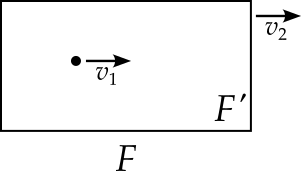
In frame \(F'\), a particle moves at velocity \(\mathbf{v}_1\), while frame \(F'\) itself moves at velocity \(\mathbf{v}_2\) with respect to our frame, \(F\). What is the velocity of the particle in our frame?
Our intuition immediately suggests that we should just add the velocities. However, considering some examples will reveal that this cannot be the case. Suppose both \(\mathbf{v}_1\) and \(\mathbf{v}_2\) point to the right, with speeds being \(v_1 = 0.6c\) and \(v_2 = 0.7c\). Adding these produces \(v = 1.3c\) — a value greater than the speed of light. But we know that nothing travels faster than light, in any frame.
Finding the correct formula is a simple application of the Lorentz transformation. Let’s work through the calculation for the case illustrated in figure 4.3, where the velocities are in the same direction. Consider two points on the path of the particle and the changes in both time (\(\delta x\)) and \(x\)-coordinate (\(\delta x\)) as the particle moves between them. Working in frame \(F'\), the definition of the velocity gives. \[ \frac{\delta x'}{\delta t'} = v_1. \] Similarly, in frame \(F\), \[ \frac{\delta x}{\delta t} = v, \] where \(v\) is the velocity we are trying to find. We therefore need \(\delta x\) and \(\delta t\), which we can find using the Lorentz transformation. \[ \begin{aligned} \delta t &= \gamma\left(\delta t' + v_2\delta x'/c^2\right),\\ \delta x &= \gamma\left(\delta x' + v_2\delta t'\right). \end{aligned} \] It is now merely a matter of performing the calculation \[ \begin{aligned} v &= \frac{\delta x}{\delta t}\\ &= \frac{\delta x' + v_2\delta t'}{\delta t' + v_2\delta x'/c^2}\\ &= \frac{\delta x'/\delta t' + v_2}{1 + v_2\left(\delta x'/\delta t'\right)/c^2}\\ &= \frac{v_1 + v_2}{1 + v_1v_2/c^2} \end{aligned} \] And so the (longitudinal) velocity addition formula is \[ \boxed { v = \frac{v_1 + v_2}{1 + v_1v_2/c^2}. } \]
While this might not be what we were expecting, we can check to see whether it makes sense by checking some limiting cases. Consider the classical limit, where both \(v_1/c\) and \(v_2/c\) are small. In this case, the denominator approaches one and the formula becomes that familiar to us from childhood. Next, consider the case where \(v_1 = c\), i.e. our particle is a photon. We find that \[ v = \frac{c + v_2}{1 + v_2 / c} = c. \] In other words, if a particle travels at the speed on light in frame \(F'\), then it travels at the same speed of light in frame \(F\). This is, of course, essential, since this is just the second postulate.
Thus far, we have only considered a particle and a frame moving in parallel. What is the velocity of a particle in our frame (\(F\)), if it moves upwards at speed \(u\) in frame \(F'\) and if frame \(F'\) moves horizontally at speed \(v\).
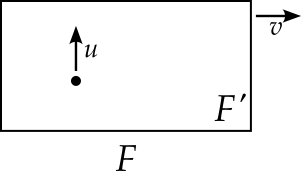
We proceed as before, but now we must consider that the resultant velocity is likely to have components in both the \(x\) and \(y\) directions. The frames, however, move in the same manner relative to each other and so we use the same Lorentz transformation. We start by noting that in frame \(F'\), \[ \delta x' = 0, \qquad \frac{\delta y'}{\delta t'} = u, \] by the definition of velocity. We need to find \(\delta x/\delta t\) and \(\delta y/\delta t\) and so we use the Lorentz transformation, as before. We find that \[ \begin{aligned} \delta t &= \gamma\left(\delta t' + v\delta x'/c^2\right) = \gamma\delta t',\\ \delta x &= \gamma\left(\delta x' + v\delta t'\right) = \gamma v\delta t',\\ \delta y &= \delta y'. \end{aligned} \] From this we find that \[ \frac{\delta x}{\delta t} = v \] and \[ \frac{\delta y}{\delta t} = \frac{\delta y'}{\gamma\delta t'} = \frac{u}{\gamma}. \] The \(x\)-component is what we would expect. However, while in this case lengths in the \(y\)-direction are not affected by length contraction, time dilation results in the vertical component of the velocity being reduced by a factor of \(\gamma\).
(For velocity addition when the particle is moving diagonally, see Morin, pp.532–533.)