2 Setting the scene
In this chapter, I will start by introducing some terminology. In particular, I will define what is meant by an inertial frame and the principle of relativity. I will then give a little of the history of special relativity, by describing the state of physics prior to 1905.
(Section 2.1 on inertial frames is examinable. The history sketched in sections 2.2 and 2.3 is not.)
2.1 Inertial frames
All of special relativity relies on us working in inertial frames. Let’s start with an intuitive definition:
Definition 2.1 An inertial frame is a reference frame that moves with constant velocity.
But this definition raises a question: a constant velocity relative to what? We need a better definition:
Definition 2.2 An inertial frame is one in which Newton’s first law holds.
So the frame of reference of a passenger on an airplane at take off is not inertial — in this frame, an object with no force acting upon it will appear to accelerate towards the back of the plane. The frame of reference of someone on a rotating carousel is also not inertial, as evidenced by the centrifugal ‘force’.
Finding frames of reference that are not inertial is easy — finding an example of an inertial frame is surprisingly difficult1. However, once we have one inertial frame, finding others is straightforward — any frame that is non-accelerating2 relative to the first must also be inertial. So, if the frame of reference of someone waiting on a station platform is considered to be inertial, then so is the reference frame of a passenger of a train moving smoothly through the station at constant velocity.
1 Am I in an inertial frame as I write these notes? It may seem so, and yet I am on a spinning planet accelerating towards the sun.
2 And hence also non-rotating.
2.2 Galilean transformations
Consider two frames of reference illustrated in figure figure 2.1. These might be for a ‘stationary’ observer at the railway station and an observer on a train moving at velocity \(v\) to the right. We will assume that at time \(t = t' = 0\), the origins of the two systems coincide, so that both observers agree on the \(x\), \(y\) and \(z\) coordinates of any event happening at that time3. The time and location of any event can be specified using \(x\), \(y\), \(z\) and \(t\) in the ‘stationary’ frame, or using \(x'\), \(y'\), \(z'\) and \(t'\) in the ‘moving’ frame. How are these coordinates related?
3 This allows us to apply transformations to the coordinates of a single event. For a contrasting approach, see Morin, pages 502-503.
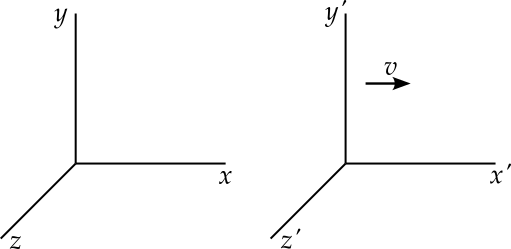
We will do this simple calculation as Galileo might have done long before the advent of special relativity, using our intuition to guide us. Consider an event at \((x', y', z', t')\) in the moving frame of reference. Common sense dictates that, having synchronised their watches, both observers will agree on the time of an event, so \(t = t'\). Clearly, we must also have \(y = y'\) and \(z = z'\). The only vaguely interesting relationship is between the \(x\) and \(x'\) coordinates. At time \(t'\), the moving frame is a distance of \(vt'\) to the right of the stationary frame. Hence, \(x = x' + vt'\). So, to summarise4: \[ \begin{aligned} t &= t'\\ x &= x' + vt'\\ y &= y'\\ z &= z'. \end{aligned} \] This is the Galilean transformation.
4 Are you feeling suspicious? Although it might be difficult to imagine, at this stage, an alternative way of relating the different coordinate systems, hopefully my use of the words ‘intuition’ and ‘common sense’ have suggested to you that, for objects travelling nearer to the speed of light, this transformation will need to be adjusted.
2.3 The principle of relativity
The principle of relativity states that the same laws of physics hold in all inertial frames. For example, you should be able to convince yourself that if Newton’s laws of motion hold in one inertial frame, then they must hold in any.
Show, using the Galilean transformation, that the acceleration of an object is the same in any inertial frame. Explain why this means that Newton’s second and third laws hold in all inertial frames.
A related concept is that of Galilean invariance, which states that the laws of physics are invariant under Galilean transformations. It was long considered that the principle of relativity and Galilean invariance were equivalent. We will find that this is not the case — we will retain the principle of relativity but be forced to discard Galilean invariance.
2.4 State of play (circa 1887)
Let’s put ourselves in the position of the physicists of the late 19th century.
Classical mechanics (and gravity): These have been well understood for a long5 time. The laws of motion and of gravity are intuitive and do not depend on the observer’s inertial frame6, i.e. they are Galilean invariant and satisfy the principle of relativity.
5 Newton’s Principia was published 200 years earlier in 1687.
6 Naturally, these laws do not apply, unchanged, in an accelerating frame.
7 Thomas Young performed his interference experiments in 1801.
Light, waves and the aether: While the nature of light had long been a source of debate, physicists have known it to be a wave phenomenon since 18197. All other waves, e.g. water waves, sound waves, etc., propagate in a medium — a water wave is a propagating disturbance in the location of the water surface. It is therefore assumed that, even in a vacuum, light must propagate in its own medium — the luminiferous aether.
Electromagnetism: The theory of electromagnetism has only recently8 been completed, while experimental validation is yet to come9. Moreover, there seem to be some problems:
8 James Clerk Maxwell published his equations in 1865
9 Heinrich Herz will provide experimental validation in the 1890s.
- The theory of electromagnetism is not (quite) Galilean invariant, so seems to break10 the principle of relativity.
- The theory predicts a wave phenomenon, that has been identified with light. This unification of electricity, magnetism and light is, of course, a great success, yet the theory predicts a single speed for light in a vacuum. A speed relative to what?
10 You will have to wait for the explanation of how electromagnetism does not break the principle of relativity.
What conclusion would you come to? You might suspect that the new theory — electromagnetism — needs fixing in some way. Or you might propose that the single predicted speed for light in a vacuum must be that relative to the aether. If this is the case, then in a frame moving relative to the aether, one would have to adjust the speed of light, and hence the laws of electromagnetism, accordingly.
What would you endeavour to find out, to test your conclusions? Well, you might attempt to find our velocity with respect to the aether.
2.5 The Michelson-Morley experiment
The Michelson-Morley experiment in 1887 was a direct approach to solving this problem. By exploiting interference11 it compared the speed of light in different, perpendicular directions. Given the Earth’s motion in its orbit12 and the sensitivity of the experiment, it should have detected a difference. It didn’t.
11 Interference and other wave phenomena will be covered later in this unit.
12 One would expect the Earth to be moving relative to the aether. Even if the experimenters were unlucky and the Earth just happened to be stationary with respect to the aether when they performed the experiment, they could just repeat the experiment 6 months later.
2.6 Inventive (and complicated) fixes
- Perhaps the Earth drags the aether with it? (Alas, this runs into difficulties regarding stellar aberration13.)
- Perhaps the motion of light depends not on the aether, but on the emitter? (But this requires horrible modifications to electromagnetism.)
- Perhaps motion through the aether squashes distances and does odd things to the passage of time? (Ooh, close — but not quite there.)
13 Stellar aberration is not a central part of this course, but feel free to look it up if you are interested.
2.7 Einstein’s solution
- The new theory of electromagnetism is entirely correct.
- Our longstanding and intuitive understanding of classical mechanics (and gravity) is what needs to be fixed.
- The aether does not exist. Light in a vacuum travels at the same speed with respect to everything.